How to Deploy and Automate DDoS Mitigation with Flowtriq in 5 Minutes
From what I’ve seen in my 15 years shipping infra and security tools, agent-first detection + automated BGP/RTBH escalation is the pattern that scales for...
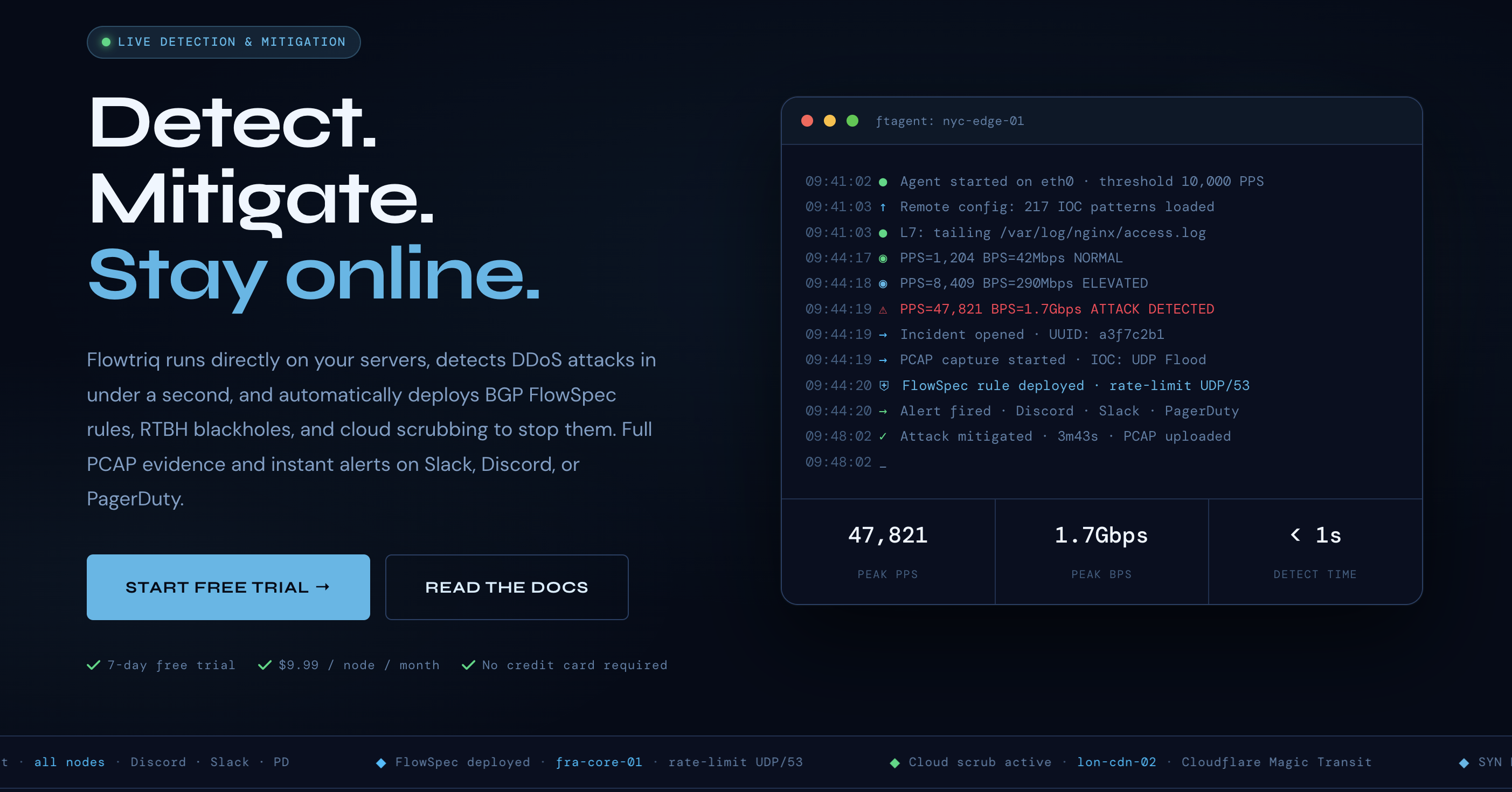
Ship DDoS mitigation that actually works — in under 5 minutes
In the next 5 minutes you'll know how to install Flowtriq, turn on automated mitigations, and stop most DDoS noise before your users notice. If you run hosting, game servers, an ISP node, or any developer tools infrastructure, the hard reality is DDoS is no longer “if” but “when.” Flowtriq’s agent-based, sub-second detection model is built for operators who need surgical, low-latency responses without the finger-wagging of cloud-only scrubbing services.
From what I’ve seen in my 15 years shipping infra and security tools, agent-first detection + automated BGP/RTBH escalation is the pattern that scales for distributed edge fleets. Here’s a practical, no-nonsense walkthrough.
Step 1: Create an account and deploy the FTAgent
- ▸Sign up at Flowtriq and start the 7-day trial (no credit card). Create an organization and add a project for the nodes you’ll manage.
- ▸Install FTAgent on a Linux server:
- ▸Download the one-line installer from the dashboard and run it as root. FTAgent is Python-based and installs in under two minutes.
- ▸Confirm the agent is running (systemctl status ftagent or ps aux | grep ftagent). The agent reads packets from the NIC and will immediately stream telemetry to the cloud.
- ▸Claim the node in the dashboard and label it (e.g., game-us-east-1 / prod-web-01). Let the agent run for traffic baseline learning — Flowtriq adapts dynamically, so avoid flipping mitigations while it’s learning.
- ▸Verify alerts channel: configure Slack/Discord/PagerDuty webhook so you see the first anomaly within 1 second.
Step 2: Core features you need to know (and how to use them)
- ▸Sub-second detection & classification
- ▸Flowtriq checks PPS every second. On an anomalous spike (SYN, UDP, DNS amp, HTTP flood), you’ll get a classification and suggested playbook.
- ▸Auto-mitigation via escalation policies
- ▸Create a policy that attempts local mitigations first (iptables drop), then FlowSpec, then RTBH, then cloud scrubbing (Cloudflare Magic Transit, OVH VAC, Hetzner) as escalation. This prevents premature cloud diversion.
- ▸PCAP on demand and forensic captures
- ▸Every detected attack triggers immutable PCAP captures for postmortem. Use PCAPs to identify botnet signatures or reproduce traffic patterns in test labs.
- ▸IOC correlation & IOC matching
- ▸Flowtriq matches traffic against hundreds of thousands of IOCs out of the box (Mirai variants included). Use custom IOC libraries on Enterprise to block targeted threats.
- ▸Automated incident runbooks
- ▸Chain mitigation steps into playbooks (e.g., block-by-ACL → FlowSpec → notify status page). Trigger webhooks to run internal automation (tickets, CI/CD gating).
Step 3: Pro tips for Developer Tools professionals
- ▸Treat Flowtriq as part of your CI/CD safety net: add a webhook-triggered playbook to automatically isolate new nodes that fail network fuzzing.
- ▸For game servers: whitelist known backend ports and tune escalation so ephemeral UDP spikes from gameplay don’t auto-divert to cloud scrubbing.
- ▸Use immutable audit logs and PCAP retention as compliance evidence — indispensable for fintech and regulated SaaS.
- ▸Group nodes by role (edge, origin, game-region) and apply different escalation chains per group — lower escalation for non-customer impacting test clusters.
- ▸Test playbooks in a maintenance window: simulate a SYN flood and watch Flowtriq progress through the escalation chain so you know exactly what happens at each step.
Common mistakes to avoid
- ▸Turning on aggressive cloud scrubbing as the first mitigation — you’ll pay performance or complexity costs. Start local, escalate.
- ▸Not allowing baseline learning time — Flowtriq’s dynamic baselines reduce false positives if you let it observe normal traffic patterns.
- ▸Forgetting to configure alerts (Slack/PagerDuty) or status pages — a silent mitigation is a support nightmare for users.
How it stacks up to other options
Flowtriq is agent-based and focused on sub-second detection plus automated BGP/RTBH escalation. Compared to Cloudflare Magic Transit or traditional scrubbing providers (Arbor, Radware, Corero), Flowtriq sits closer to your servers and gives you more surgical, node-level control — and a flat per-node price ($9.99/month). Use Flowtriq to detect and triage quickly, and escalate to global scrubbing only when needed.
Conclusion: Is Flowtriq right for you?
If you operate distributed Linux nodes (hosting providers, game servers, ISPs, SaaS) and need fast, automated, low-cost DDoS defense that integrates into your operational runbooks, Flowtriq is a strong fit — especially when you value sub-second detection, built-in forensic PCAPs, and predictable pricing. Try the 7-day trial, deploy FTAgent on a non-production node, and walk through an escalation playbook in a safe window. Celebrating developers who ship means protecting their users — Flowtriq helps you do that without slowing your delivery pipeline.
[STALL LOCATION]
Flowtriq