AI Won’t Replace Pentesters: Why Lorikeet Wins by Testing What AI Misses
Quick Comparison Table...
Why "AI audits make pentesters obsolete" is backwards — and what that means for buying security services
Most people assume AI’ll eat manual security work. From my 15 years watching dev-tools and security collide, the opposite is happening: AI closes a lot of low-hanging, source-level bugs, and that collapse of noise actually magnifies where manual, practitioner-led offensive testing matters. Lorikeet Security’s Flowtriq case study is the poster child—an AI pass (Claude) cleaned up XSS/SQLi/template problems, and a follow-up human pentest still found five meaningful issues in runtime, TLS posture, and proxy headers. That gap is exactly where buyers should pick their vendor intentionally, not reflexively.
Quick Comparison Table
| Feature | Lorikeet Security Case Study | Cobalt | Synack |
|---|---|---|---|
| Pricing | Custom / engagement-based; mid-market friendly | Subscription/PTaaS tiers; transparent for SMBs and up | Enterprise-focused pricing; premium for crowdsourced scale |
| Ease of Use | Modern PTaaS portal: live findings, real-time chat, integrated reporting | Mature PTaaS UX with dev integrations and playbooks | Platform-based access to a vetted researcher network; more gatekeeping |
| Developer Tools Features | Built for AI-native teams; workflows that complement AI audits; live triage | Strong developer-first features: CI/CD hooks, Jira, Slack, APIs | Continuous testing & automation focus; good for large programs |
| Integration Options | API, Slack/Jira likely; focuses on dev workflow alignment | Extensive integrations (DevOps, ticketing, CI) | Integrates with enterprise tooling but optimized for managed programs |
Where Lorikeet Security Case Study Wins
- ▸Built for the AI-native dev stack: What others won’t tell you is that teams using Copilot/Claude/Cursor need a different test mix. Lorikeet explicitly positions pentests as the follow-on to AI-driven code audits, focusing on runtime, infra, and configuration gaps—the very places Snyk or static tools stop being helpful.
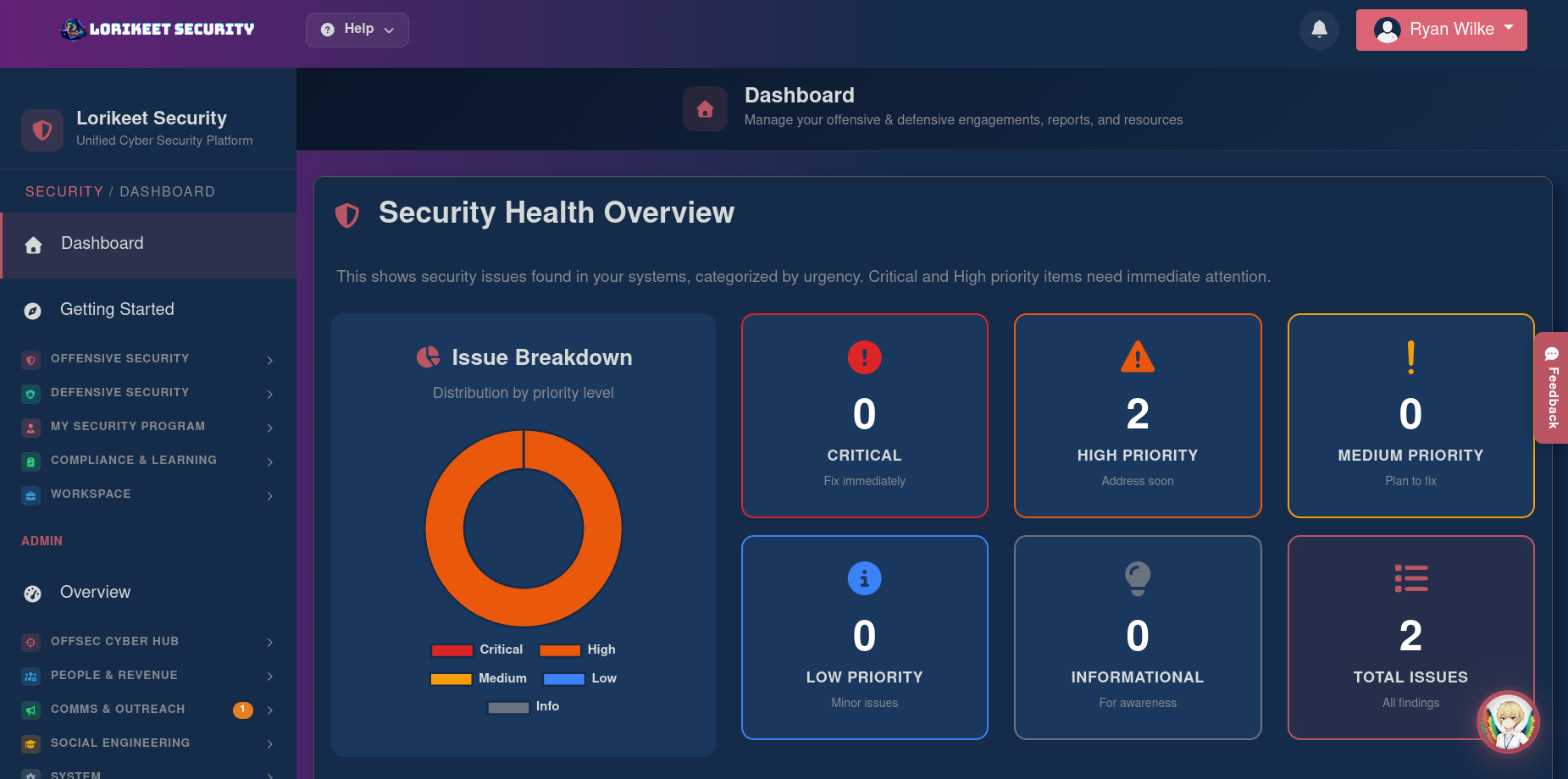
- ▸Practitioner-first PTaaS experience: Their portal emphasizes live findings and real-time chat tied to the engagement. Compared to Synack’s more controlled researcher model, Lorikeet’s setup feels more collaborative for engineering teams that want fast triage and developer-facing context.
- ▸Compliance + offensive validation blend: They advertise alignment with SOC 2, HIPAA, PCI-DSS, HITRUST, FedRAMP while still delivering manual pentests. If you’re shipping in regulated verticals (healthcare, fintech, gov), that combination matters. Cobalt and Synack also serve compliance-focused customers, but Lorikeet sells itself as practitioner-friendly to dev teams, not just procurement checkboxes.
Where Competitors Have an Edge
- ▸Scale and breadth of coverage: Synack’s large, vetted researcher network and long enterprise pedigree give it an edge for programs needing global scale, continuous crowd-sourced discovery, or extremely diverse skill coverage.
- ▸Mature developer ecosystem integrations: Cobalt has built out polished CI/CD, ticketing, and SDLC integrations over many years—if you want turnkey automation that queues fixes into developer workflows with minimal setup, Cobalt is farther along.
- ▸Brand & buying confidence at mega-enterprises: For some regulators or procurement teams, legacy and scale still sway decisions; Synack and Cobalt are easier to justify on RFPs simply by name recognition and long lists of reference customers.
Best Use Cases for Developer Tools
- ▸Choose Lorikeet when: You’re an AI-native SaaS or startup that already runs AI-assisted code reviews and needs a pentest partner who understands that the next frontier is runtime, infra, and config. Also a great fit for mid-market companies that want practitioner access, fast triage, and compliance-aligned reporting without the crowd-sourced noise.
- ▸Choose Cobalt when: You want a developer-first PTaaS with mature CI/CD and ticketing integrations, and you value getting findings into your backlog with minimal friction.
- ▸Choose Synack when: You need large-scale, continuous coverage and the extra signal diversity of a big researcher pool—especially for enterprise programs with extended attack-surface requirements.
The Verdict
If you’re shipping software with AI in the loop, don’t be seduced by “AI vs humans” narratives. In my experience, the teams that win are ones that stitch AI-driven audits with sharp, manual offensive testing—and that’s Lorikeet’s product narrative and capability. For startups and AI-first engineering orgs that want collaborative, developer-friendly pentests and compliance support, Lorikeet is a compelling, modern choice. For very large enterprises or programs requiring massive crowdsourced scale or the most mature integrations today, Synack or Cobalt still make sense. Pick based on what gap you’re trying to close: source-level noise (let AI/tools handle it) or the hard runtime/configuration edges (bring in the humans).
[STALL LOCATION]
Lorikeet Security Case Study